
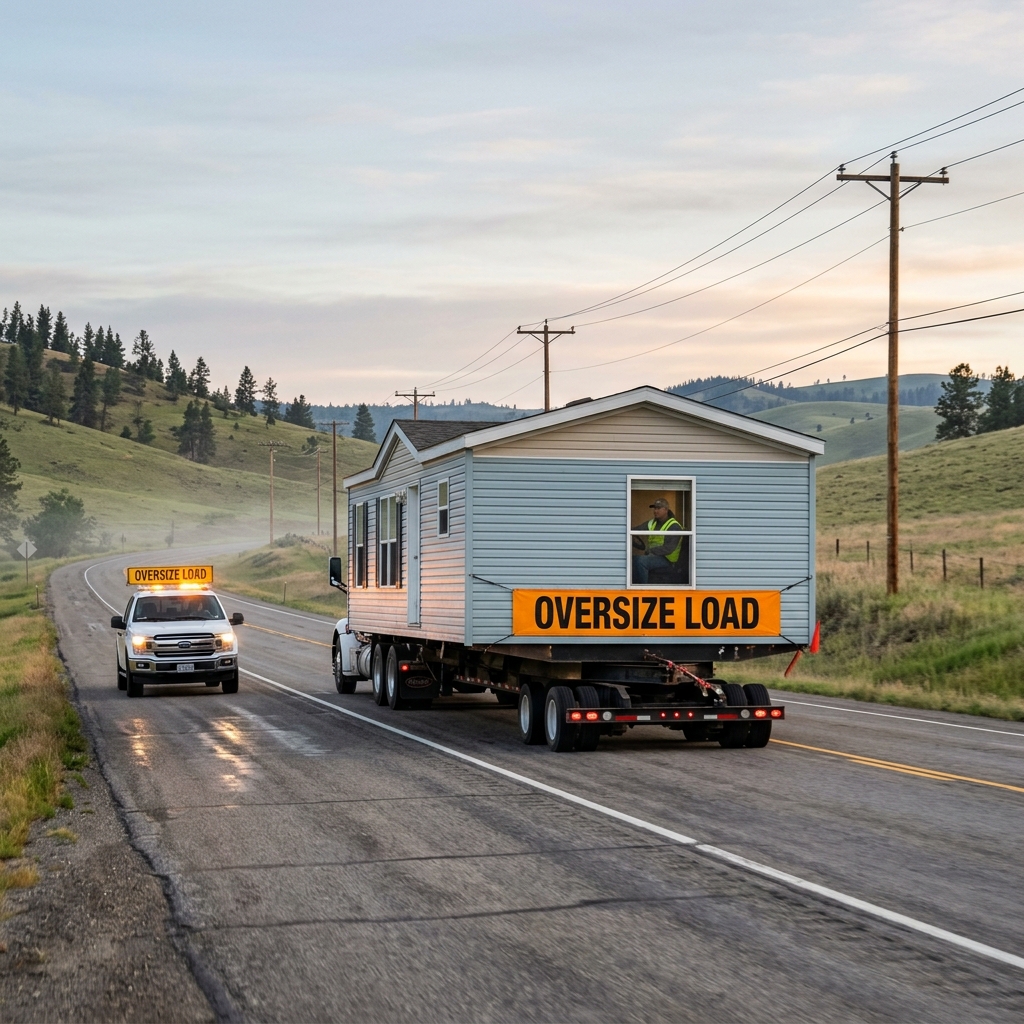
How Manufactured Home Transport Actually Works
Moving a manufactured home is heavy-haul work, not furniture removal. A finished home section is a single rigid object between roughly 50 and 80 feet long and 14 to 18 feet wide, riding on its own steel chassis and axles behind a specialised tractor known as a toter. Everything that makes the job complicated follows from those dimensions.
The information below is general and applies to manufactured housing transport across the United States. Permit rules, escort requirements and travel restrictions are set state by state and change, so the authority for any specific move is the permit issued by each state along your route.
Why Every Move Is an Oversize Load
The standard legal load width on US highways is 8 feet 6 inches. A single-section home is typically 14 or 16 feet wide, and a multi-section home travels as two or more sections of the same width. Every one of those moves therefore exceeds the legal limit and needs an oversize, and often overweight, permit from each state crossed — and in some places from individual counties and municipalities as well.
Permits are not generic. They are issued for a stated width, height, length and weight, over a defined route, within a defined date window. Change the route or the dimensions and the permit has to be reissued. Common conditions attached to those permits include:
- Daylight-only travel, often defined as sunrise to sunset, with movement prohibited in fog, snow or high winds.
- Curfews around peak commuting hours in and near metropolitan areas.
- Holiday and weekend restrictions, which vary substantially between states.
- Escort requirements that scale with width: broadly, loads past about 12 feet wide start attracting a pilot vehicle, and wider loads require more, with police escorts sometimes required on specific roads.
- Seasonal load restrictions, such as spring thaw weight limits on secondary roads in northern states.
The Route Survey
Before a move is booked, the route is surveyed. The survey is looking for the things that physically stop a wide, long, tall load: bridge and overpass clearances, weight-posted structures, turning radii at intersections and roundabouts, low overhead power and telephone lines, roadworks, narrow bridges, and railway crossings with steep approaches that a long chassis will ground out on.
Where the route cannot avoid a low line, utility companies are contacted to lift or temporarily de-energise it, which is scheduled work with its own lead time and cost. A route problem discovered during the survey is a scheduling matter. The same problem discovered on delivery day is a stranded home, an idle crew, and permits that may need reissuing.
What Your Site Needs on Delivery Day
The last two hundred feet defeat more deliveries than the preceding two hundred miles. The practical checklist for the receiving site is:
- A firm approach. The ground has to carry a loaded truck and a home without rutting or sinking. Soft ground after sustained rain is one of the most common reasons a delivery is postponed.
- Width and turning room at the property entrance and at every corner on the way in, including space for the pilot vehicles.
- Overhead clearance from branches, service drops and signage.
- A working area around the pad large enough to manoeuvre, jack and position the section — and, for a multi-section home, to bring the second half alongside the first.
- A prepared pad. Delivery and set-up are separate operations, but a home cannot be placed on ground that has not been graded, compacted and footed. See what site preparation involves before scheduling transport.
Moving a Home You Already Own
Relocating an existing home is a different job from delivering a new one. A sited home has to be disconnected from utilities, stripped of skirting, and re-fitted with axles, tires and a hitch before it can legally travel; older homes may need brake and lighting work to be roadworthy. The structure also has to be sound enough to survive the loads of a move, which is a genuine question for homes that have been in place for decades.
There are legal constraints too. Some jurisdictions restrict where older manufactured homes may be relocated, and many communities and lenders treat homes built before 15 June 1976 — legally mobile homes rather than manufactured homes, because they predate the HUD Code — very differently. If the home is titled as personal property, the title and any lien must be dealt with before it moves across state lines. The FAQ covers the HUD Code date and titling in more detail.